Design Process
The design process for The Witch of Wish Mountain started with my interest in fae and fairy folklore. As this isn’t a common genre or style I sat down and defined what fae is to me (1st image below). From this definition I realised a strong part of my perception of the fae involved their domains or courts that they controlled. Using folkloric beliefs as a base, the courts came to occupy elements of the world that are unknowable to real-world humans. These courts were then split in two with one (the Seelie fae) representing lighter and traditionally “good” ideas and the other (the Unseelie fae) representing darker and traditionally “evil/bad/scary” ideas (2nd image below). Through this process, I found another aspect of fae that was deeply important to me was their gender. Fae and fairies tend to be seen as more fem/feminine yet in these stories the women present act in very nongendered or even masculine ways. Alongside this, there are a number of myths and stories that do feature men that are outside of the public consciousness. This complicated relationship with gender led me to decide that all fae would be fae gendered (meaning they use fae/faer/faers pronouns) to address the relationship while further distancing the fae characters from societal norms. All of these ideas combined with traditional tropes from fairytales to form the six possible location to visit in the game (3rd image below).
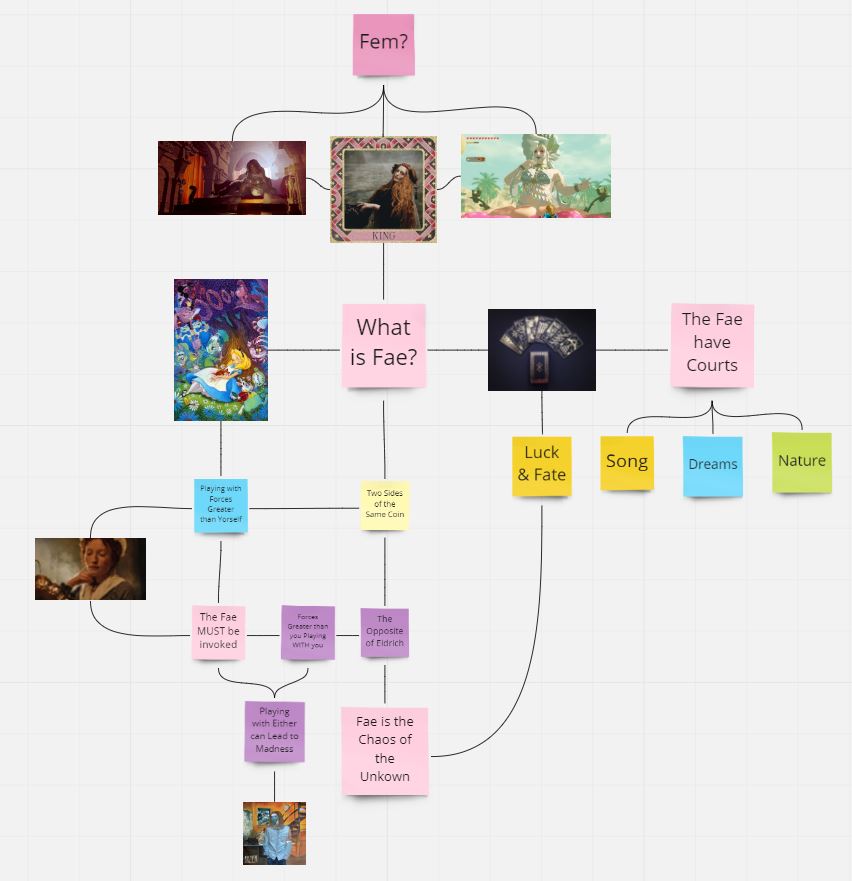
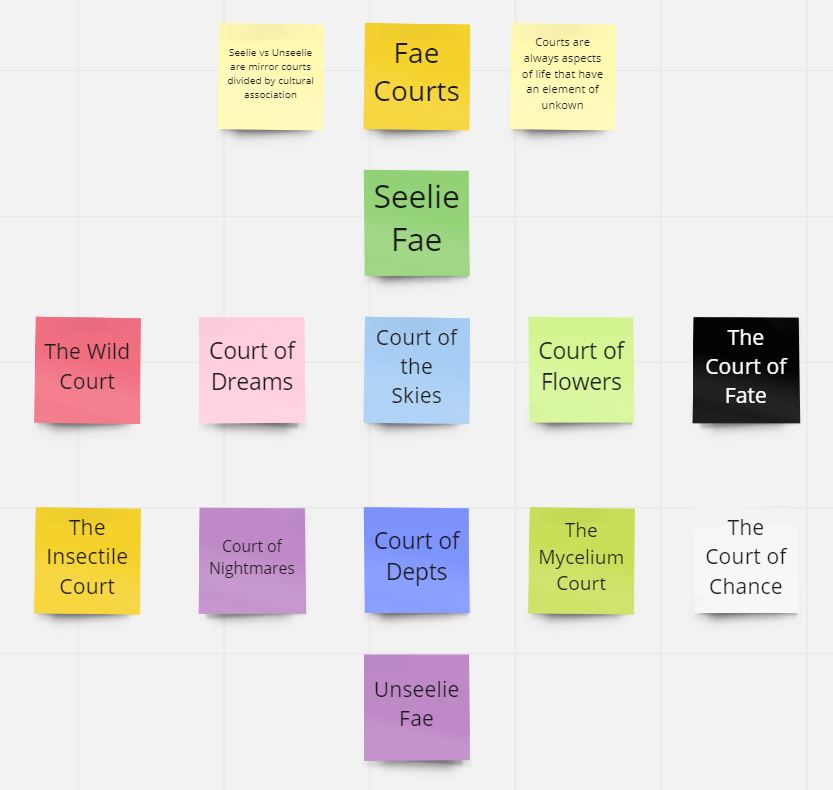

Beyond here the design process drew on text adventures and choose your own adventure books. Both of these genres take mechanical inspiration from TTRPGs and so I decided to do the same. I chose the 2-stat system which used d6s and revolved around balancing two stats between a value of 0 and 6 without hitting those extremes. This mechanic also emphasised an element of the fae a found interesting, that being humanity’s inability to interact with them for prolonged periods of time without serious consequences (such as in Alice in Wonderland). As a result, I named the 2-stats magic and mundane to represent the two worlds the player straddles during play. Once all this was decided the game become a simple process of writing all the text required for the game’s narrative and implementing it in the Unity plug-in Fungus (chosen for its simplicity and ease of use).
Game Documentation
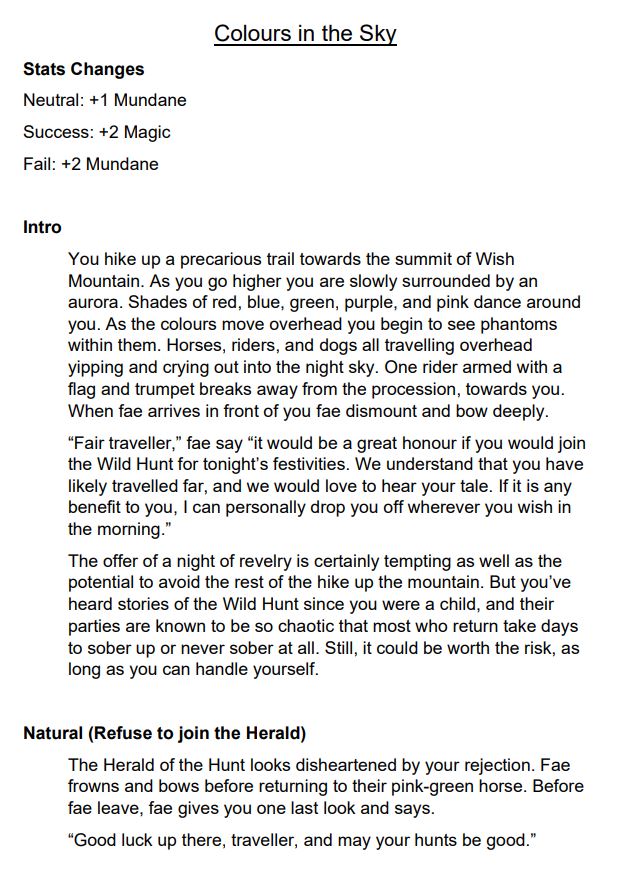
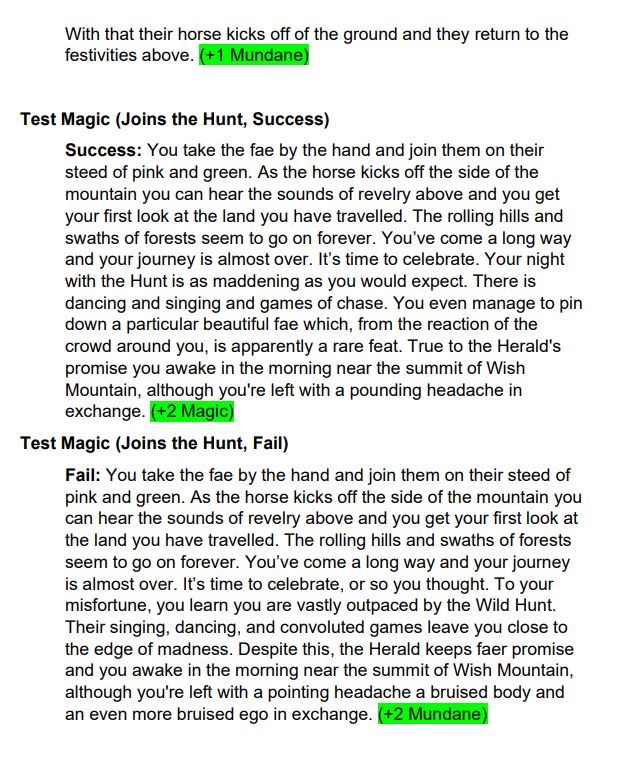
As The Witch of Wish Mountain is mostly a text adventure the core piece of documentation became a combination of game script and numerical tracker of how and when the player’s stats changed throughout the game. Below is a sample of the documentation for 3 different encounters in the game.
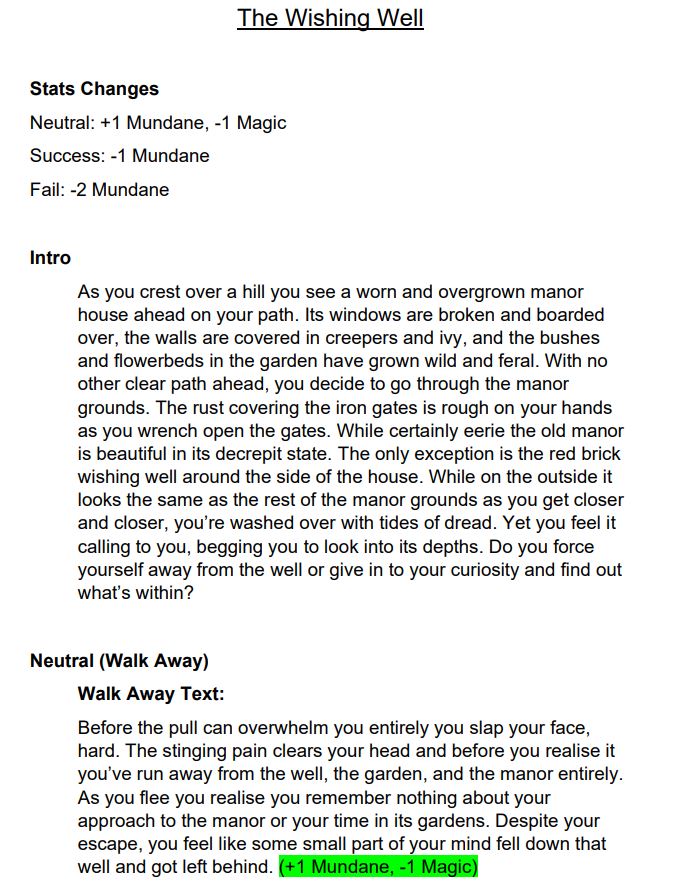

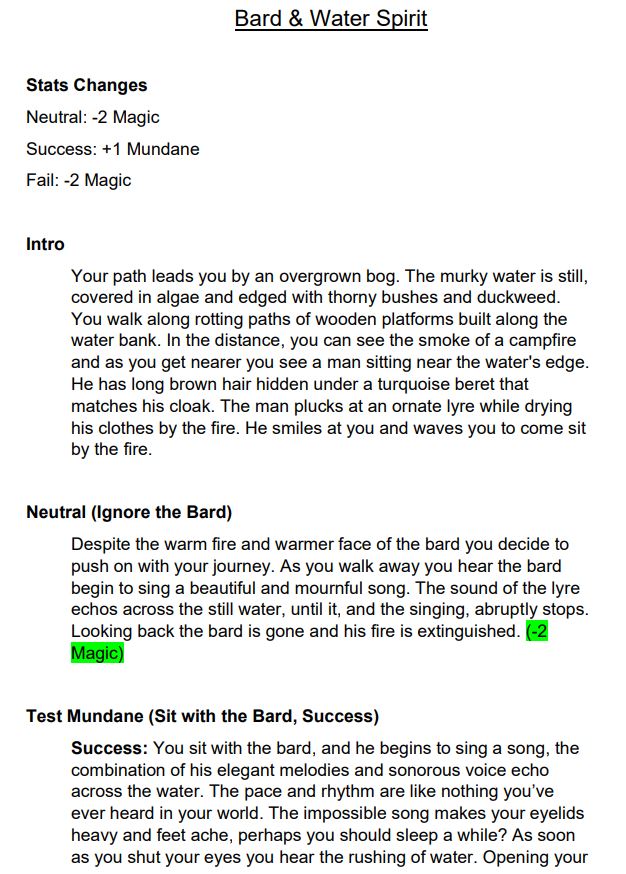

My Strengths
My main strength in The Witch of Wish Mountain was my writing and world-building. As mentioned above I spent a lot of effort on the setting of the game and how it relates to the player’s character. Alongside this, I really like each area because each has a distinct fae feeling but in a vast array of directions, from camp and comical to sadistic and creepy. I think the branching paths in each area also help to build the world in the player’s eyes depending on their successes and failures. My only regret with the writing was not using software that allows for more integration based on player choices, however, the game text currently sits at around 10,000 words and expanding it further would have been too great a workload for me at the time.
Lessons Learnt
I learnt many lessons while making this game. The first and foremost was about consistency in design, presentation, and writing between areas. The game’s text went through multiple rewrites as the further I got into development the more depth and detail the story contained. In particular, about halfway through making the game, the final three areas had almost twice as much text as the first three. Another important lesson I learnt was about selecting the right tool and using it effectively, if I had explored fungus more before beginning my writing process I could have enhanced the writing even further to better fit with the interesting things the plug-in let me do. Finally, the project ran into issues of scale and time management and so things like game art had to be cut too far more simplistic elements than I originally intended. Thankfully the game still stands strong despite these issues and I am able to better scope my projects in the future by learning how much time different tasks take me to complete.
 Portfolio | Daniel Cox