Design Process
Red String is my attempt at turning amateur detective work into a playable experience. The idea for the game began with an interest in niche internet mysteries and true crime being combined with the desire to create a more tactile way of playing beyond reading various documents.


While creating the initial design I quickly realised that amateur detective work is, for better or worse, closely linked with the world of conspiracy theories. I didn’t want to re-work Red String to focus on this but I did want to incorporate the elements of uncertainty and belief that the two groups share. This led to the creation of the two documents shown above where every element follows relatively standard cycles of investigation and thought but with an added complicating element that plants doubt in the player’s minds. I chose occult magic to be this seed of doubt due to its pre-existing connection to crimes and conspiracy without being attached to any real conspiracy theories. The idea of doubt and uncertainty also led to another evolution of the game. A lot of games currently available that have a similar style of gameplay revolve around concrete answers confirmed either by an online companion site or by a game master, but this isn’t how mysteries work. In real life, you never get told if you’re on the right track or if you’ve successfully solved the crime. Wanting to emulate this did, however, open up a big problem of how to create a satisfying experience with no defined conclusion. This led to the conspiracy board.

I re-framed my game from being focused on unravelling a mystery into being essentially a collaborative mind-mapping exercise. Rather than being played in a single session, it could be played out in however much time the player(s) wanted. The conspiracy board provided the tactile element of gameplay I desired while maintaining the open-endedness of real mysteries. Players could read documents and make notes at any pace they liked for them or another player building on their work sometime later. This also had the benefit of simulating online conspiracy forums where people make posts that others can add to days or even weeks later. Finally, it provided two loose phases to the game. The first phase involved people connecting and questioning the game documents. The second involved players interrogating each other’s theories and connections. This second phase would theoretically lead to a split in the players, the same split that can be found in real conspiracy theory communities, those who are believers and those who are sceptics.
Creation Process
Beyond this point, most design work focused on planning and writing the game documents and ensuring they provided the right amount of detail for players to understand what is going on without being bored. A core part of this process was focusing on players’ expectations. While I wanted to subvert their expectations with the game’s narrative the way it was shown needed to match expectations rather than reality. This came from most people not understanding how police work and documentation is actually done, instead basing their understanding of TV and film. This came through in many small ways but the most noticeable is how the game’s legal system works like the British policing system on the ground level and the US system at the higher level. To this end, the documents were also made to fit the right balance of clear readability for play and dry bureaucratic documentation for immersion.
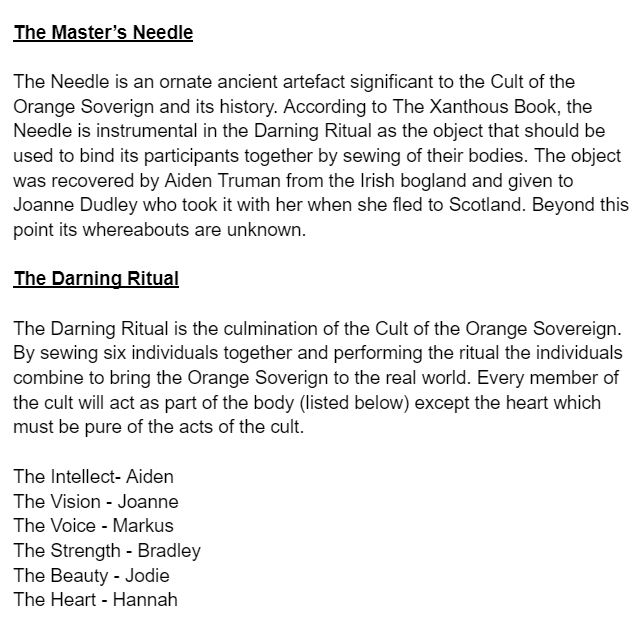
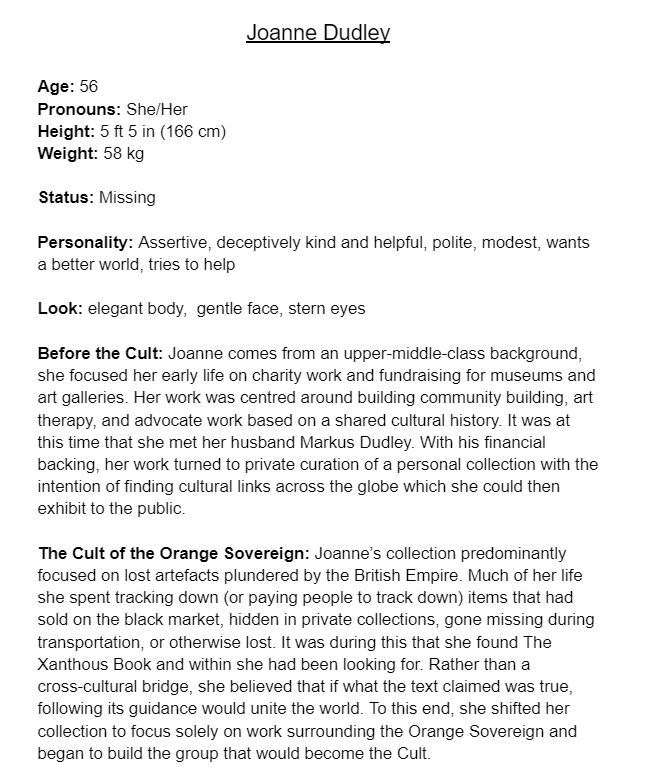
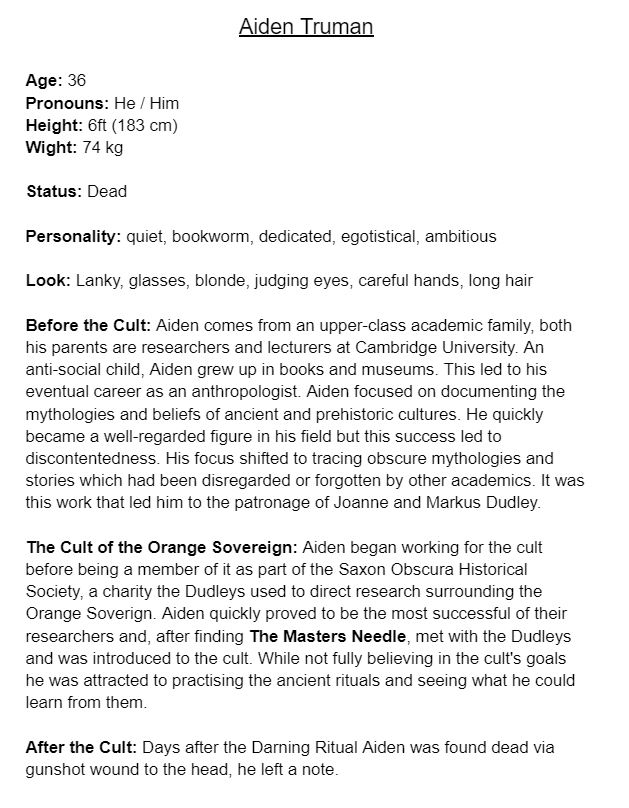
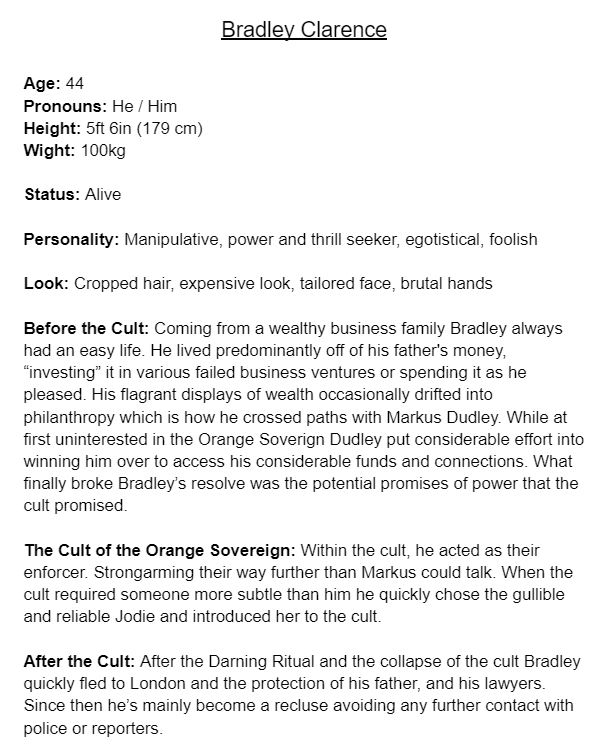
Finally, planning the game’s story involved three steps. The first was making character profiles for the important characters in the case and outlining the mythos of the cult and their beliefs. Then the second and third documents were made together, one was a timeline of the characters and their involvement in the case (including areas of ambiguity for players to theorise over) and the other was a complete list of every document I would need to make to communicate the story to the player in an interesting way. Both of these documents were somewhat fluid during development with the timeline changing order and new documents being added to fill gaps I did not foresee.
Game Documentation
The initial backbone of development was the two pages of handwritten notes that can be found at the top of the page. However, creating the documentation that made up the meat of the game’s content still required planning, lore documents, and organisational work, some of which can be found below.


My Strengths & Lessons Learnt
Red String lent into my strengths as both a writer and designer, allowing me to push both of these skills in new directions with an unusual form of storytelling. A lot of development and testing was spent on expanding my knowledge of players and how they interact with games and interpret their stories. If anything though the most important lesson learned from Red String is that of planning. Both how much time it takes and how crucial it can be to making this complex of a game.
Counting design documentation, character planning, research, and solo play tests about 2/3 of Red Strings development was spent on the various planning elements. I think the most powerful aspect of these plans was their flexibility. I credit this flexibility with the re-focusing of the game on the conspiracy board as without it that process would have taken a ground-up redesign of the entire game.
If I was to go back to this game, or even this style of game, I would focus on the areas of ambiguity more. Admittedly, within Red String, the ambiguous elements are more limited than I had hoped partially due to time constraints but also my lack of faith in players to follow the game’s narrative. This led to players feeling like they had “solved” the game more quickly than I hoped, limiting interactions with the conspiracy board. To this end, I would make the game documents less clear-cut and add more puzzle-like elements to (eg: codes or cyphers) that players could solve collaboratively throughout the game. This has the added benefit of slightly limiting the flow of information to players and giving them a reason to return to the board after their first visit.
 Portfolio | Daniel Cox